What Is Waterfall Enrichment? The Complete 2026 Guide
You scraped 1,000 leads and your email finder returned 550 — with 450 blanks. Waterfall enrichment fixes that 45% hole by cascading through 15+ data providers until each contact has a verified email, charging only for results. Here’s how it works, what it costs and when to use it.
What waterfall enrichment actually is
You scraped a clean list of 1,000 prospects from Sales Navigator. You run it through your email finder. It comes back with 550 emails — and 450 blanks. That 45% hole in your list is the problem waterfall enrichment was invented to solve.
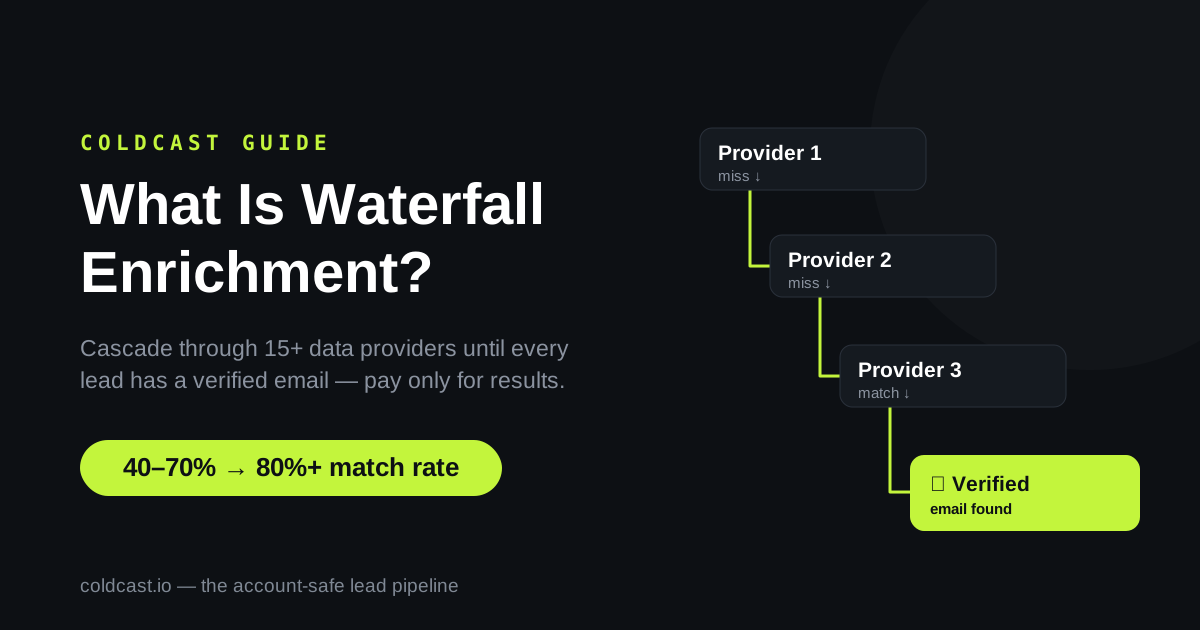
Waterfall enrichment is the practice of querying multiple data providers in sequence — one after another, like water falling down a series of ledges — until a verified email or phone number is found for each contact. Instead of relying on one vendor’s database, you cascade through five, ten or fifteen. Provider A misses? Ask Provider B. Provider B misses? Ask Provider C. Each contact only stops cascading when a valid result comes back.
At Coldcast, waterfall enrichment is built directly into the Waterfall Enricher — and because Coldcast starts from account-safe Sales Navigator scraping, your leads arrive already clean, deduplicated and ready to enrich without ever putting your LinkedIn account at risk.
Why single-provider enrichment falls short
No single B2B data provider covers the whole market. Every vendor — Apollo, Hunter, Dropcontact, Prospeo, Kaspr and the rest — has its own coverage strengths by region, industry and company size. One might be strong on US SaaS contacts but weak on European manufacturing; another is the reverse.
In practice, a single provider typically finds a valid email for somewhere between 40% and 70% of a B2B list. That means for every 1,000 leads you paid to source, 300–600 are unusable — not because those people don’t have emails, but because *that particular database* doesn’t have them.
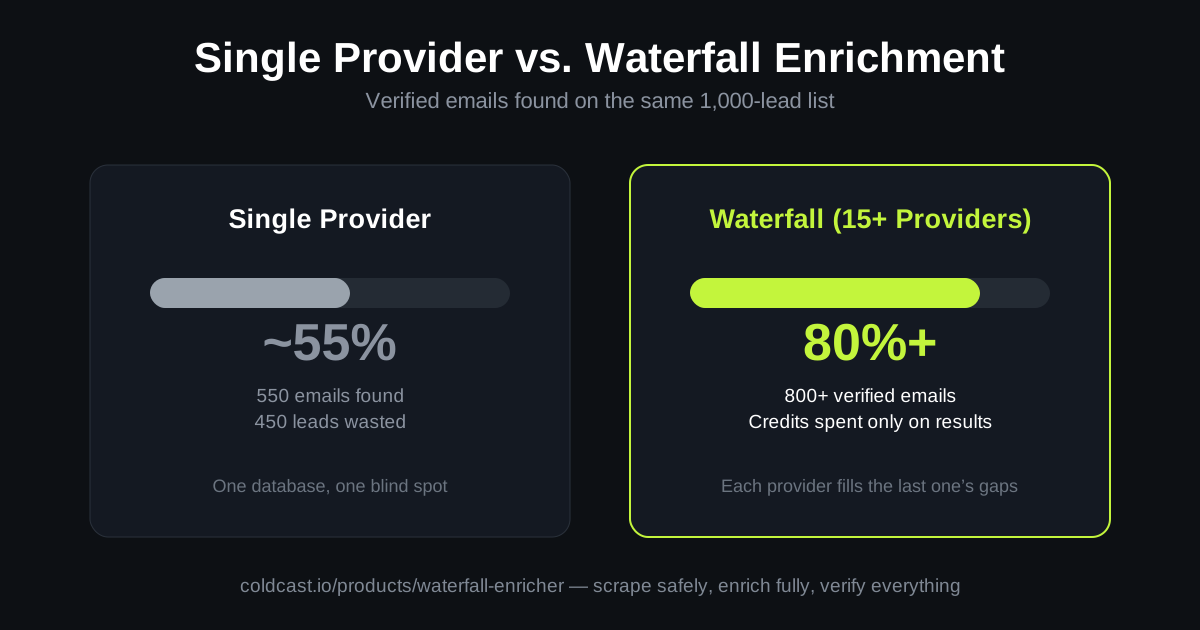
Waterfall enrichment attacks the coverage problem directly. Vendors that run waterfalls across 10–20 sources routinely report combined match rates of 80% or higher on the same lists, because each provider fills a slice of the gaps the previous one left. The math is simple: the union of fifteen databases is always bigger than any one of them.
How waterfall enrichment works, step by step
1. Start with an identity anchor. Every waterfall needs a reliable starting point: usually a LinkedIn profile URL, or a full name plus company domain. The cleaner the input, the better every downstream provider performs — which is why scraping quality matters so much. A Sales Navigator export full of truncated names and “LinkedIn Member” rows will underperform no matter how many providers you cascade through. Coldcast’s Sales Navigator scraper cleans names, strips emojis and certifications, and resolves company domains before enrichment even begins.
2. Query providers in sequence. The engine sends the contact to Provider 1. If a result comes back, the cascade stops for that contact. If not, it moves to Provider 2, then 3, and so on. Good engines order providers dynamically — putting the vendors with the best historical hit rate for that segment (geography, industry, seniority) at the top of the cascade, which finds results faster and cheaper.
3. Verify every result. A found email is not a usable email. Catch-all domains, stale records and recycled addresses mean raw finder output can bounce at 10–20% if sent unchecked. Serious waterfall systems verify each result before returning it — checking MX records, mailbox existence and catch-all status. Coldcast runs every waterfall result through its own email verification layer, so what lands in your CSV is deliverable, not just “found.”
4. Return one clean field per contact. The output you want is a single verified email (or phone) per lead — not fifteen conflicting guesses. The waterfall’s job is to collapse a messy multi-vendor landscape into one trustworthy column in your export.
Waterfall enrichment vs. buying multiple subscriptions yourself
You could replicate a waterfall manually: subscribe to Apollo, Hunter, Snov.io and Prospeo, export your misses from each, and re-upload to the next. People genuinely did this in 2022–2023. The problems:
- Cost — you pay four full subscriptions but each one only earns its keep on a fraction of your list.
- Time — every hop is a manual CSV export/import with dedupe work in between.
- Waste — most standalone tools charge credits per *lookup*, not per *result*, so you burn credits on misses.
Waterfall platforms flip that economics. The dominant model in 2026 — used by Coldcast and most credible competitors — is pay-per-valid-result: a credit is only consumed when a verified email or phone actually comes back. Misses are free.
What does waterfall enrichment cost in 2026?
Honest market context, verified August 2026:
- FullEnrich cascades across roughly 15+ providers; entry pricing starts around $29/month for 500 credits, at 1 credit per verified business email and 10 credits per mobile number — no credits deducted on misses.
- BetterContact advertises 20+ data sources; plans start at $15/month for 200 credits, with the same 1-credit-per-email / 10-credits-per-phone structure, charging only on found-and-verified results.
- Apollo and Clay both offer waterfall-style enrichment inside their broader platforms — powerful if you already live in those ecosystems, but you inherit their pricing models and, in Clay’s case, premium-credit multipliers.
These are capable tools. The difference with Coldcast is where the waterfall sits in your workflow. FullEnrich and BetterContact enrich lists you bring to them — the risky part, getting the leads out of Sales Navigator, is your problem. Coldcast handles the full chain: account-safe extraction from Sales Navigator (built to mimic human browsing and respect LinkedIn’s rate limits so your account stays safe), automatic cleaning, waterfall enrichment and verification — one pipeline, one tool. If your leads come from Apollo or ZoomInfo instead, the same waterfall applies there too.
When waterfall enrichment is worth it (and when it isn’t)
Use a waterfall when:
- You’re running cold outbound at volume, where each 10-point gain in match rate directly multiplies pipeline.
- Your ICP spans regions or industries — exactly where single-provider coverage is patchiest.
- You need mobile numbers, where individual provider hit rates are low and cascading matters most.
- You’re paying an SDR team to prospect; blank rows are payroll waste.
Skip it when:
- You have a tiny, high-touch target list (25 named accounts) — manual research beats any database.
- Your existing single provider already hits 85%+ on your niche (rare, but it happens in dense US tech segments).
- Your bottleneck is copy or deliverability, not contact coverage. More emails into a burned domain helps nothing — fix verification and warm-up first.
Best practices for waterfall enrichment in 2026
Start from clean, deduplicated input. Garbage in, garbage cascaded through fifteen providers, garbage out. Fix names and domains before enriching.
Always verify, never just find. If your waterfall doesn’t include a verification pass, add one before sending. Bounce rates above 3% will damage your sender reputation.
Enrich right after scraping, not weeks later. B2B data decays at roughly 2–3% per month as people change jobs. The best time to enrich a Sales Navigator export is the same day you pull it. New to exporting? See our guide to exporting Sales Navigator leads to CSV.
**Watch your cost per *valid* contact, not cost per credit.** A cheaper tool with a 55% match rate is more expensive per usable lead than a pricier one hitting 80%.
Keep the whole chain account-safe. Enrichment is only as good as the lead source feeding it. Aggressive scrapers that get your Sales Navigator account restricted don’t just cost you LinkedIn access — they cut off your entire pipeline upstream of the waterfall. It’s covered in depth in how to scrape Sales Navigator without getting banned.
The bottom line
Waterfall enrichment is not a gimmick — it’s the logical response to a fragmented B2B data market. No single database sees everyone, so the winning move is to query many and verify what comes back. In 2026 the technique has gone from a Clay-table power-user trick to table stakes for serious outbound teams.
If you want the waterfall built into the same account-safe pipeline that gets your leads out of Sales Navigator in the first place, try Coldcast’s Waterfall Enricher — or let the Coldcast Agent run the whole scrape-clean-enrich-verify loop for you.
Frequently asked questions
What is waterfall enrichment in simple terms?
Waterfall enrichment means checking multiple data providers one after another until a verified email or phone number is found for a contact. If the first provider doesn’t have the data, the request “falls” to the next provider, and so on — which is why combined match rates beat any single database.
How much does waterfall enrichment improve match rates?
A single provider typically finds valid emails for 40–70% of a B2B list. Cascading across 10–20 providers routinely pushes combined match rates to 80% or more, because each provider covers gaps the others miss. Exact gains depend on your list’s geography, industries and seniority mix.
Do I pay for contacts the waterfall can’t find?
Not with modern tools. The standard 2026 model — used by Coldcast, FullEnrich and BetterContact — is pay-per-valid-result: credits are only consumed when a verified email or phone is actually returned. Failed lookups cost nothing.
Is waterfall enrichment better than using Apollo or Clay directly?
Apollo and Clay both offer waterfall-style enrichment inside their platforms, and they’re good options if you already use those ecosystems. A dedicated pipeline like Coldcast differs by combining account-safe Sales Navigator scraping, cleaning, waterfall enrichment and email verification in one flow — so you don’t stitch together a scraper, an enricher and a verifier separately.
How many data providers should a waterfall use?
More providers help, with diminishing returns after roughly 10–15 for emails. Order matters as much as count: good engines rank providers by historical hit rate for your specific segment, so most contacts resolve within the first few hops — faster results and lower provider load.
Does waterfall enrichment work for phone numbers too?
Yes, and it’s arguably even more valuable there. Individual providers’ mobile-number hit rates are much lower than email hit rates, so cascading across many sources makes the biggest relative difference for phone enrichment. Expect phone results to cost more credits than emails (10:1 is the common ratio).