Is LinkedIn Scraping Legal? What the Law Actually Says in 2026
Scraping public LinkedIn data isn’t a crime, and no salesperson has been prosecuted for exporting Sales Navigator leads. But “not a crime” isn’t the whole story: criminal law, LinkedIn’s terms, and privacy law each answer a different question. Here’s where you actually stand.
The short answer
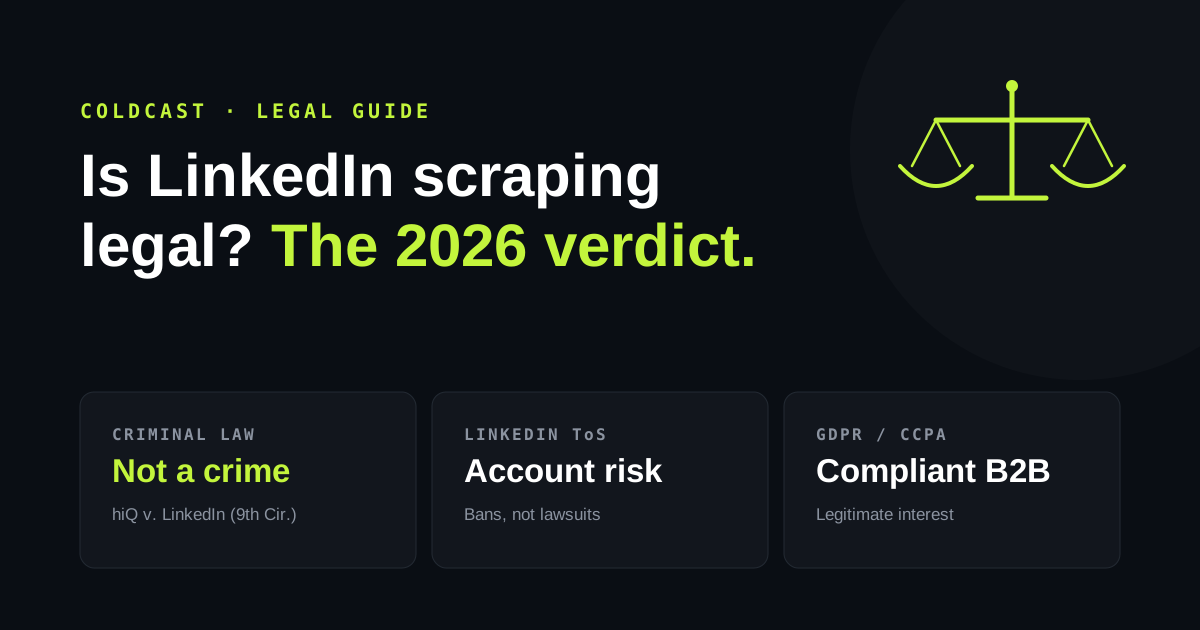
Scraping publicly available LinkedIn data is not a crime, and no salesperson has ever been prosecuted for exporting Sales Navigator leads. But “not a crime” isn’t the whole story. LinkedIn scraping sits at the intersection of three different kinds of rules — criminal law, LinkedIn’s terms of service, and privacy regulations like GDPR — and each one answers a different question.
This guide walks through all three, in plain English, so you know exactly where you stand before you export your next lead list. (The usual caveat: this is general information, not legal advice — if you have a specific compliance question, talk to a lawyer.)
The three questions people actually mean by “is it legal?”
When someone asks whether LinkedIn scraping is legal, they’re usually asking one of three things:
- Will I get in trouble with the law? (criminal and civil liability)
- Will LinkedIn ban my account? (terms of service)
- Can I lawfully use the data for outreach? (GDPR, CCPA and privacy law)
These have different answers, and conflating them is where most of the fear-mongering comes from. Let’s take them in order.
Question 1: Is scraping LinkedIn a crime? (hiQ v. LinkedIn)
The landmark case here is hiQ Labs v. LinkedIn, which ran from 2017 to 2022 and shaped how US courts think about web scraping. hiQ was an analytics startup that scraped public LinkedIn profiles. LinkedIn argued the scraping violated the Computer Fraud and Abuse Act (CFAA) — the US federal anti-hacking statute — and hiQ sued; the case went up to the Ninth Circuit twice.
What the courts decided. The Ninth Circuit ruled (2019, reaffirmed 2022) that scraping publicly accessible data does not violate the CFAA: the statute targets accessing computers “without authorization,” and data open to the public doesn’t require authorization in the first place — you can’t “hack” a page anyone can view. The Supreme Court’s decision in Van Buren v. United States (2021) reinforced this “gates-up-or-down” reading. But hiQ still lost the war: in late 2022 the case ended with a settlement and consent judgment after the district court found hiQ had breached LinkedIn’s User Agreement — a contract claim, not a hacking claim.
What that means for you. Scraping public LinkedIn data is not a criminal act in the US. The real exposure is contractual: when you log in, you accept a User Agreement that prohibits automated data collection, and LinkedIn can enforce it — primarily by restricting the account that breaks it. Notably, in Meta v. Bright Data (2024), a court found that logged-*out* scraping of public data didn’t even breach the platform’s terms, underlining that the contract question turns on the account, not the scraping itself. For a sales team, LinkedIn’s realistic enforcement isn’t a lawsuit — you’re not a venture-funded data reseller — it’s account restriction.
Question 2: Will LinkedIn ban my account?
LinkedIn’s User Agreement (Section 8.2) prohibits using bots or other automated methods to copy data from the service. Violating it isn’t illegal — breaching a website’s terms is a contract issue — but LinkedIn’s remedy is swift and practical: warnings, temporary restrictions and permanent bans. This is where scraping tools differ enormously, and it’s the risk that should drive your choice of tool:
- Machine-speed automation and cookie-replay bots pilot your LinkedIn session at machine speed — visiting hundreds of profiles an hour, clicking in perfect rhythm, with no real limits. LinkedIn’s detection is built to spot exactly this, and detection means your account (and your Sales Navigator subscription) takes the hit.
- Chrome extensions that inject code into LinkedIn’s pages are detectable too — LinkedIn can see modified page structures and abnormal request patterns from your session.
- Account-safe scrapers stay within human-like rate limits, avoid injecting anything detectable into your session, and throttle extraction to mimic normal Sales Navigator usage.
This is the design philosophy behind Coldcast’s Sales Navigator scraper: the scraping problem isn’t “can you get the data” — any tool can — it’s “can you get the data without LinkedIn noticing anything unusual about your account.” For the operational detail, we’ve written a full guide on how to scrape Sales Navigator without getting banned.
Question 3: Can you lawfully use scraped data for outreach? (GDPR & CCPA)
Even though collecting public data isn’t a crime, the moment you process personal data — names, job titles, work emails — privacy law applies. This is the layer most scraping guides skip, and the one with real regulatory teeth in Europe.
GDPR (EU/UK prospects). GDPR applies wherever your prospects are in the EU or UK, regardless of where your company sits — and it does not prohibit B2B prospecting. Cold outreach to business contacts can rest on the legitimate interest basis (Article 6(1)(f)), provided you handle the data responsibly: use business data for business purposes; tell people where you got their data (Article 14 — in practice a line in your first email noting you found them on LinkedIn); honour opt-outs immediately and suppress deleted contacts rather than re-enriching them; and don’t hoard data beyond a genuine prospecting purpose.
CCPA (California prospects). California’s CCPA/CPRA is lighter-touch for B2B: the core obligations are disclosure and honouring deletion/opt-out requests. Respond to those promptly and ordinary B2B prospecting is workable.
Where verification fits. Regulators care about data quality too — GDPR’s accuracy principle means you shouldn’t be emailing stale addresses. Running exports through email verification and waterfall enrichment isn’t just deliverability hygiene; it keeps your outreach list accurate, current and defensible.
So what’s actually risky? A practical hierarchy
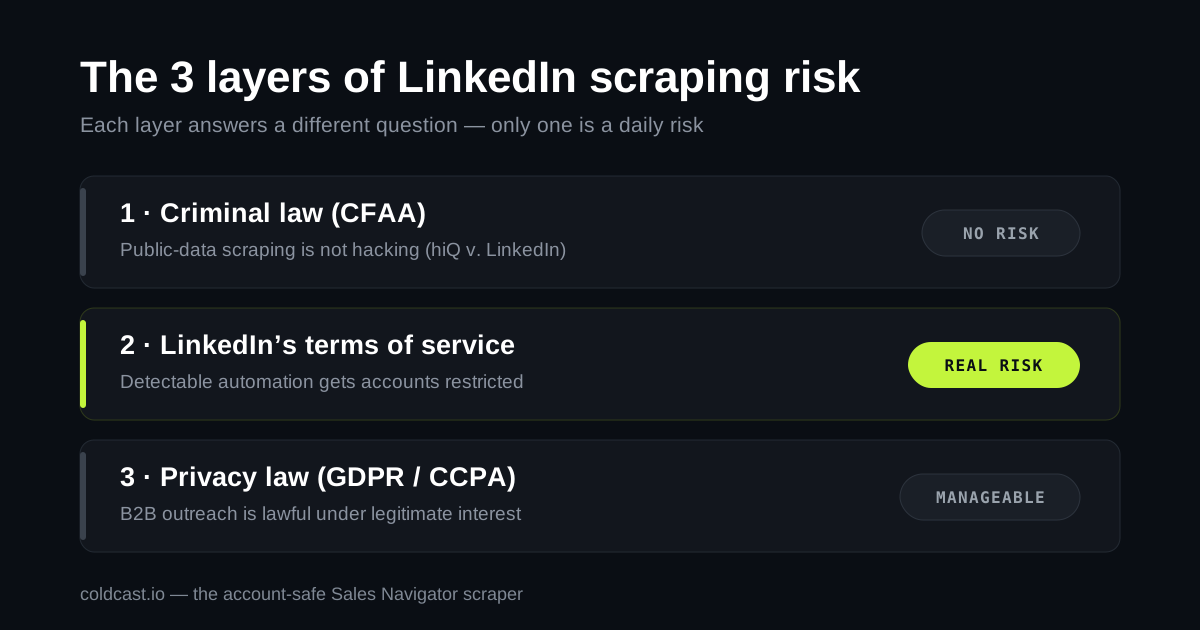
Putting the three layers together, here’s how the risk actually stacks up for a typical sales team:
- No realistic risk: criminal prosecution for exporting public B2B lead data. The CFAA question was settled by *hiQ* and *Van Buren*.
- Low, manageable risk: privacy-law issues — if you follow the B2B outreach practices above (relevance, transparency, opt-outs, accuracy).
- The real risk: losing your LinkedIn account because your tool scraped in a way LinkedIn detects. This is the one that happens every day, and the one entirely within your control through tool choice.
In other words: the question isn’t so much “is LinkedIn scraping legal?” as “is my scraper safe?”
How Coldcast approaches this
Coldcast was built as the safest way to get leads out of Sales Navigator, and that design maps directly onto the three layers above:
- Public-data extraction at human-like rates keeps your account clear of LinkedIn’s automation detection — no injected code, no machine-speed profile visits.
- [Waterfall enrichment](/products/waterfall-enricher) finds work emails from multiple providers, and [email verification](/products/email-verify) confirms them before you send — so your list stays accurate and GDPR-defensible.
- Clean CSV export means you control the data: easy to honour deletion requests, easy to document where a contact came from. See our walkthrough on exporting Sales Navigator leads to CSV.
Frequently asked questions
Is scraping LinkedIn a criminal offense?
No. US courts held in hiQ v. LinkedIn that scraping publicly accessible data does not violate the Computer Fraud and Abuse Act. There is no criminal statute against collecting public profile data, in the US or the EU. The risks are contractual (LinkedIn’s terms) and regulatory (privacy-law compliance) — not criminal.
Can LinkedIn sue me for scraping?
Technically LinkedIn can bring a breach-of-contract claim against users who violate its User Agreement, as it did against hiQ Labs. In practice, LinkedIn litigates against large-scale commercial data resellers, not individual sales professionals. For normal users, LinkedIn’s enforcement is account restriction, not lawsuits.
Is it legal to scrape emails from LinkedIn?
Most scraping tools, including Coldcast, don’t take emails from LinkedIn itself — they enrich scraped names and companies through third-party databases to find work emails. Using business contact data for relevant B2B outreach is lawful under GDPR’s legitimate-interest basis, provided you disclose your data source, keep data accurate, and honour opt-outs.
Does GDPR ban cold outreach to scraped leads?
No. GDPR regulates how you process personal data; it doesn’t prohibit B2B prospecting. Cold email to business contacts can rely on legitimate interest if the pitch is relevant to the recipient’s role, you tell them where you got their data, and you honour opt-outs immediately. Some EU countries layer additional e-privacy rules on top, so check local rules for your key markets.
What’s the safest way to export Sales Navigator leads?
Use a tool that extracts at human-like rates without injecting detectable code into your LinkedIn session, then enrich and verify emails outside LinkedIn. Coldcast’s Sales Navigator scraper was built around exactly this account-safety principle — the difference between tools that get data and tools that get data while keeping your account alive.